
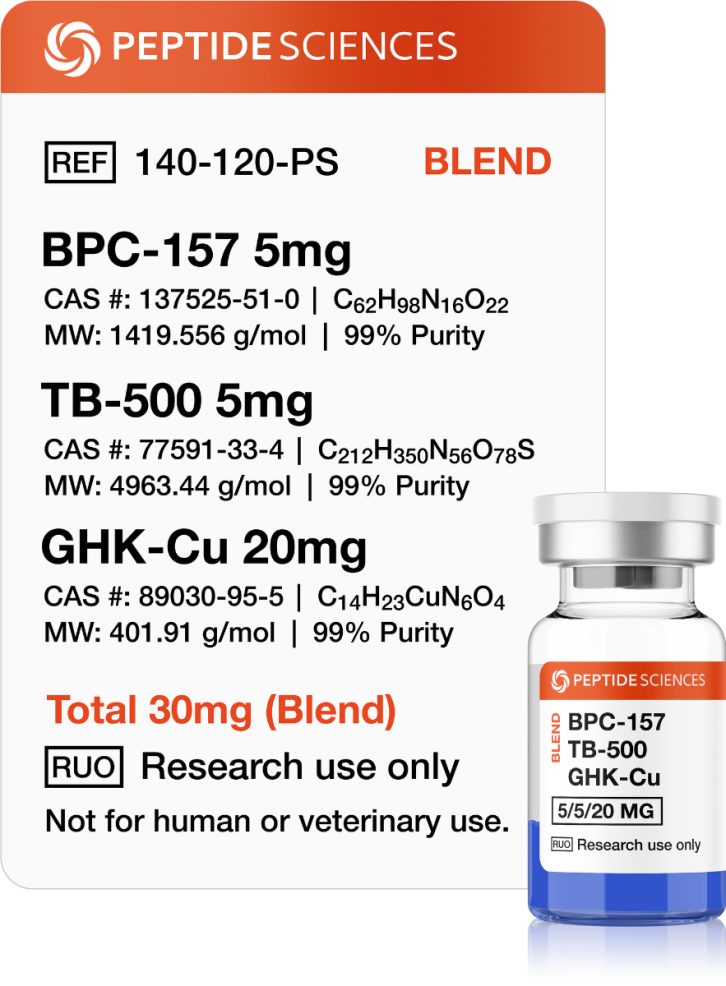

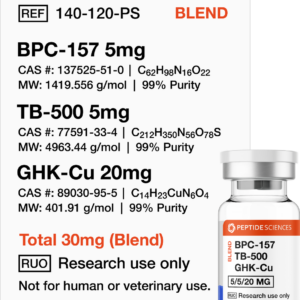
BPC-157, TB-500, GHK-Cu (Glow Blend)
$165.00
BPC-157 10mg, TB-500 (Thymosin Beta-4) 10mg, GHK-Cu 40mg
(60mg Total Glow Blend) Click Here BPC-157, TB-500, GHK-Cu (Glow Blend) 30mg Mechanisms and Synergy BPC-157: A stable gastric pentadecapeptide shown to accelerate angiogenesis, fibroblast migration, and epithelial repair via modulation of VEGFR2, FAK-paxillin pathways, and nitric oxide signaling. It enhances tendon, muscle, and intestinal healing in preclinical models. TB-500 (Thymosin Beta-4): A 43-amino acid actin-sequestering peptide that promotes tissue regeneration through cell migration, angiogenesis (via VEGF upregulation), and anti-inflammatory effects. It mobilizes progenitor cells and accelerates repair of myocardium, dermis, and connective tissue. GHK-Cu: A copper-binding tripeptide (glycyl-L-histidyl-L-lysine) that stimulates wound healing, collagen synthesis, and hair growth. It modulates gene expression linked to tissue remodeling and exerts antioxidant and anti-inflammatory effects through TGF-β and metalloproteinase regulation. Synergistic Benefits:
Combined research with BPC-157, TB-500, and GHK-Cu may offer synergistic tissue regeneration and anti-inflammatory benefits by concurrently activating multiple repair pathways: Angiogenesis: TB-500 and BPC-157 both promote VEGF-mediated vascularization, while GHK-Cu enhances endothelial cell proliferation. Cellular migration and matrix remodeling: TB-500 improves actin polymerization and cellular motility; GHK-Cu and BPC-157 stimulate ECM production and fibroblast activity. Anti-inflammatory modulation: All three reduce oxidative stress and cytokine-driven inflammation, potentially improving healing in chronic or complex injuries. This multifactorial synergy suggests enhanced efficacy in musculoskeletal, dermatological, and post-surgical recovery applications.
BPC-157 + TB500 (Thymosin Beta 4) + GHK-Cu Blend
BPC-157, TB500, and GHK-Cu are, separately, some of the most potent anti-inflammatory peptides that have been investigated. Each of these peptides has been found to promote wound healing, slow tissue decay, promote muscle and tendon growth, alter DNA expression patterns, and even thwart the effects of aging. Despite their similar properties, however, each of these peptides works in a different way to bring about its various effects. Thus, logic would dictate that using these peptides in conjunction with one another could result in synergies in each of the areas mentioned above.
To aid in research into the combined effects of these peptides, a BPC-157 + TB500 (Thymosin Beta 4) + GHK-Cu Blend has been created. This blend makes ordering, storage, dosing, and administration of these peptides easier, allowing researchers to focus on measuring outcomes and designing experiments rather than creating protocols for administering multiple individual peptides.
What follows is a look at how BPC-157, TB500, and GHK-Cu might work in conjunction and why they might produce synergistic (i.e. enhanced effects) when used in combination. This overview will likely provide some guidance on what animal studies using these peptides in combination might uncover and where scientists should expect to see results.
BPC-157: Biochemistry
BPC-157 is a penta-decapeptide derived from the naturally occurring Body Protective Compound (BPC). BPC was originally derived from human gastric contents and has been shown to have potent anti-inflammatory and wound-healing properties. Animal studies have indicated benefit in the GI tract, liver, pancreas, ligaments, muscles, tendons, cornea, heart, brain, and nerves.
The precise way in which BPC-157 produces its effects is still not clearly understood. For instance, it isn’t clear if the peptide binds to a cell surface receptor to produce its effects or if it is transported into the cell and perhaps has effects directly at the level of the DNA. A few things about BPC-157 have become clear from the research, however. First, BPC-157 has profound effects on nitric oxide (NO) signaling. Many of its properties are thought to relate, in some way, to the ability of BPC-157 to influence NO signaling at the levels of eNOS expression.
Second, BPC-157 is rapidly absorbed and distributed throughout the body. Research shows that 10 minutes after administration, BPC-157 can be found relatively evenly spread throughout the body including kidney, liver, stomach wall, thymus, gonads, and spleen. Peak levels of the peptide are achieved in tissue approximately 1 hour after administration and then slowly decline over the next 48 hours [1]. Levels tend to me highest in kidney, liver, thymus, and spleen with slightly lower levels in lung, muscle, brain, and skin.
The third thing that can be concluded about the biochemistry of BPC-157 is that it alters gene expression patterns. Again, the mechanism by which this occurs has yet to be elucidated, but the peptide definitely alters expression patterns of:
• Egr,
• Nos (especially eNos),
• Srf,
• Vegr,
• Plcγ, and
• Kras.
These genes control the synthesis of a number of factors that affect cells of blood vessels and the immune system such as adhesion, thrombosis, and inflammatory responses. The levels of each gene increased or decreased based on the timeframe following administration of BPC-157. This suggests that BPC-157 is working through a regulatory mechanism that has fine-grained control over a wide array of genes and their expression.

An Overview of the complex actions of BPC-157 in the body. Note the profound effects on NO signaling and VEGF expression as well as several impacts on inflammatory cytokines.
Source: MDPI
It is important to return to the fact that one of the major actions of BPC-157 (if not THE major action) is in nitric oxide (NO) signaling. Research shows that BPC counteracts the deleterious effects of L-NAME, which has been known to cause ulceration in the GI tract. Additionally, BPC-157 has been shown to positively influence nitric oxide synthase (NOS and especially eNOS), leading to increased expression of several antioxidant enzymes, such as heme oxygenase (HO-1). At the same time, nitric oxide (NO) produced by NOS plays a dual role. While it can exhibit cytotoxic effects, it also contributes to immune responses and is essential for the functioning and development of neurons. NO can directly bind to the heme group in NOS, initiating a variety of chemical and biochemical processes. These include NO deoxygenation, which is linked to its scavenging and vasoconstrictive effects—particularly relevant in conditions like hemolytic disorders—as well as the S-nitrosylation of hemoglobin, a process implicated in lung injury and associated with elevated red blood cell production[2].
TB500: Biochemistry
TB500 is a derivative of thymosin beta-4, a naturally occurring protein with known anti-inflammatory and tissue healing properties. Like thymosin beta-4, TB500 primarily works to bind actin and regulate gene expression. It has shown benefits in heart health, muscle repair, immune regulation, and the central nervous system. It even has been shown to promote hair growth and to fight the effects of aging.
TB500 has two primary mechanisms of action. First, within the cell TB500 works to sequester actin and thus regulate everything from cell motility to growth and division. This role is critical to everything from wound healing to the movement of cells of the immune system to where they are needed. Boosting cell motility via TB500 administration has been shown to accelerate wound healing, reduce inflammation, and promote blood vessel growth.
The second role of TB500, which is sometimes referred to as moonlighting, is to regulate inflammation through changes in gene expression patterns rather than via actin sequestration. Research shows that TB500 alters the expression of genes involved in nitric oxide synthesis, blood vessel growth, cell proliferation, and more. These effects, in fact, are very similar to the downstream effects of BPC-157 discussed in the previous section. TB500 essentially alters the secretion patterns of various cytokines and plays a key role in modulating multiple signaling pathways related to the inflammatory response. It helps reduce inflammation by regulating the NF-κB and Toll-like receptor pathways and by suppressing the release of pro-inflammatory cytokines such as TNF-α and IL-1 receptor-associated kinases. TB500 also activates a number of tissue repair pathways including PI3K/Akt/eNOS, Notch, and angiopoietin-1/Tie2 to support regeneration. Additionally, it modulates the TGF-β pathway to reduce fibrosis (i.e. scarring). There is even evidence showing that TB500 influences Wnt signaling to promote the formation of hair follicles and boost hair growth at the level of DNA[3]. The diagram below offers some insight into the complex and wide-ranging influences of TB500.

An overview of the complex signaling pathway of Thymosin Beta-4 and therefore TB500.
Source: PubMed
GHK-Cu: Biochemistry
GHK-Cu is a naturally occurring coper complex consisting of a short peptide bound to copper II. It was first isolated in human plasma, but has been found in saliva and urine as well. It has been shown in animal studies to be important in wound healing and inflammatory responses. It is well-known for its ability to stimulate collagen synthesis as well as skin fibroblast growth. As a result of these latter properties, GHK-Cu is found in many cosmetic products where it is touted as an anti-aging ingredient.
GHK-Cu is thought to work by stimulating the synthesis of enzymes called metalloproteinases. These enzymes break apart certain proteins to promote wound healing. It also stimulates the production of anti-proteases, which prevent the breakdown of other proteins. Like BPC-157, GHK-Cu appears to coordinate a complex mechanism of protein deposition and breakdown via gene regulation. Thus, it helps to coordinate the overall process of wound healing, particularly dermal repair.

This is just one of several pathways by which GHK-Cu is thought to work. Note the downstream impacts on inflammatory cytokines and immune cell infiltration that help to reduce inflammation and therefore tissue damage. Note also the increase in production of antioxidant rejuvenators like superoxide dismutase and glutathione.
Source: PubMed
BPC-157 + TB500 (Thymosin Beta 4) + GHK-Cu Blend: Anti-Inflammatory Effects
After briefly touching on the limited amount that is known about how BPC-157, TB500, and GHK-Cu are thought to work, it is important to explore some of the known benefits of these peptides and why they may provide enhanced impacts when used in combination. The most important property that all three peptides share in common is their ability to control the inflammatory response and help guide it in the direction of improved healing.
Of the three, BPC-157 has the most obvious anti-inflammatory effects. In study after study, BPC-157 has shown the ability to tame inflammation when it gets out of control. Chronic inflammation, which leads to pain and disability, is thought to be a dysregulation of an appropriate inflammatory process. In other words, when the body loses control over the inflammatory process, bad things start to happen. BPC-157 appears to be uniquely suitable in restoring that control. In fact, in recent research BPC1-57 was found to almost completely eliminate inflammation in the setting of interstitial cystitis, a bladder condition that heretofore was thought to be uncurable[4].
BPC-157 regulates nitric oxide synthesis, one of its primary anti-inflammatory mechanisms of action. Nitric oxide, after all, is critical in the inflammatory processes, helping to regulate blood vessel dilation, immune response by cells like macrophages, cytokine release, tissue repair, and more. Nitric oxide (NO) is particularly important in regulating inflammation in the nervous system, with dysregulation of NO linked to multiple neurodegenerative diseases[5].
Unlike BPC-157, TB500 appears to regulate inflammation by inhibiting the production of cytokines like TNF-α and interleukin-6. These cytokines are critical in imitating and perpetuating the inflammatory response and are the targets of prescription monoclonal antibodies like Remicade and Humira. Reduction in signaling by these molecules has been used to treat inflammatory bowel disease, rheumatoid arthritis, psoriasis, and a multitude of other autoimmune diseases[6], [7].
Together, these two peptides attack inflammation from different angles, potentially resulting in superior suppression of the inflammatory response even at low doses. The ability to use low doses means more beneficial effects with fewer side effects. Of course, the addition of GHK-Cu may allow for even greater synergy because the anti-inflammatory effects of GHK-Cu overlap with both BPC-157 and TB500. Research shows that GHK-Cu is a free radical scavenger that interacts with nitric oxide to help prevent some of its negative effects. Too much NO leads to free radical production and eventual tissue damage. GHK-Cu scavenges these free radicals and could thus mitigate the most serious side effect of increasing NO levels.
GHK-Cu is also able to suppress TNF-α and interleukin-6 signaling, thus boosting the effects of TB500 while simultaneously freeing up TB500 to provide benefits through its other actions by altering blood vessel growth and cell proliferation patterns. This actually results in TB500 being used more to stimulate wound healing rather than reduce inflammation, resulting in a boost to the overall healing process. Of course, once healing is complete, then inflammation is no longer necessary, so by freeing TB500 up to speed wound healing, GHK-Cu likely shortens the overall time for healing a significant amount.
BPC-157 + TB500 (Thymosin Beta 4) + GHK-Cu Blend: Tissue Repair
Tissue repair can span a lot of concepts from skin injuries to diabetic ulcers and from muscle tears to tendon ruptures. These peptides are best thought of as general healing peptides. They help with tissue repair in almost every corner of the body. Together, they are likely to provide substantially faster recovery not just from accidental injury, but from surgery as well.
BPC-157 is a potent peptide for wound healing, working from the start of the injury to the end to speed up the process and to promote greater structural coherence in the repair. Research in tendons, for instance, indicates that the use of BPC-157 can vastly improve long-term outcomes and ensure a better functional outcome (e.g. improved mobility following tendon repair). Research also indicates that BPC-157 on it own can reduce the timeline to recovery following injury by as much as 80%[8].
BPC-157 has a myriad of effects on wound healing, all of which are detailed in the page dedicated exclusively to BPC-157. For this blend, it is worth focusing on the ability of BPC-157 to increase growth hormone receptor expression of fibroblasts, the cells primarily responsible for tissue repair following injury[9]. Growth hormone has long been known to increase rates of tissue repair following injury, but supplementation can lead to serious side effects like abnormal long bone growth and heart disease. BPC-157 provides an almost perfect solution to this problem by increasing the concentration of growth hormone (GH) receptors on fibroblasts near the site of injury. This results in a localized increase of GH that provides the benefits seen in wound healing while avoiding the side effects caused by increased systemic levels of growth hormone.
As noted, fibroblasts are the primary cells responsible for wound healing and BPC-157 helps to supercharge their activity by increasing GH receptor expression. These already enhanced fibroblasts can be further stimulated through TB500 supplementation. TB500 increases rates of collage deposition by fibroblasts, which provides the scaffolding necessary for blood vessel growth and tissue construction. What is more, TB500 activates satellite cells, which are stem cells that differentiate to become the cells necessary for repair[10]. Thus, with fibroblasts putting down more collagen and extracellular matrix and new cells entering the differentiation pathway, wound healing proceeds at a rapid clip.
The healing process, like any construction process, produces a lot of waste. In the body, that waste comes in the form of free radicals, which are reactive molecules that can damage cells and extracellular matrix. By improving anti-oxidant responses, GHK-Cu can help to mitigate this damage and thus keep inflammation at a minimum while a wound is healing. Research shows that a reduction in free radicals can limit scar formation during wound healing, leading to improved long-term outcomes. In short, GHK-Cu helps to preserve the benefits of BPC-157 and TB500 while reducing collateral damage from the accelerated healing process[11], [12].
BPC-157 + TB500 (Thymosin Beta 4) + GHK-Cu Blend: Anti-Bacterial Properties
The anti-bacterial properties of these peptides could be discussed in the section on wound healing because preventing bacterial overgrowth is critical to rapid and successful wound healing. That said, the profound anti-bacterial properties of these peptides deserve dedicated recognition.
TB500 has several benefits in thwarting microbial growth. First and foremost, TB500 has anti-microbial properties that limit the growth of bacteria and fungus. More importantly, TB500 can help to improve both natural and synthetic antibiotic penetration into tissue, resulting in higher concentrations of antimicrobials in the very areas where they are needed.
GHK-Cu has a different way of reducing bacterial infection in wounds. Research shows that GHK-Cu can decrease rates of infection in wounds by 27% by interacting with fatty acids from damaged tissue to create a potent anti-microbial cocktail that fights off both bacterial and fungal infections[13]. This mechanism of action is different from that of TB500 and likely works synergistically with it to create an environment that is very hostile to microbial growth.
BPC-157 has not specific anti-microbial activity, but it does play a supporting role in preventing microbial growth. By increasing blood supply to a wounded area, BPC-157 helps to increase the penetration of immune system cells that fight off infection while simultaneously carrying away debris and damaged tissue that could foster microbial growth.
BPC-157 + TB500 (Thymosin Beta 4) + GHK-Cu Blend: Anti-Aging Effects
Taken together, the benefits of BPC-157, TB500, and GHK-Cu in promoting tissue repair and reducing inflammation mean that these peptides have potent anti-aging properties. Afterall, the human body maintains itself through constant repair and rebuilding. These processes become compromised as we age, which is why we don’t recover as quickly from injury as we do when we are younger and why we are more susceptible to everything from infection to heart disease and neurodegenerative disease. In fact, much of the aging process is a result of the breakdown of tissue repair processes and the subsequent increase in inflammation that occurs when these processes become dysregulated. This alone suggests that we can slow or reverse the aging process simply by finding ways to boost tissue repair and mitigate some of the side effects of dysregulated repair mechanisms. This is why anti-oxidants are so popular and why exercise and diet are so critical. Slowing the aging process is less about the cause of injury that it is about the recovery from it. What follows is a brief discussion of the multitude of ways in which each of these peptides has been found to fight the effects of aging.
TB500 is being explored as a powerful tool in regenerative therapies, especially important for addressing age-related tissue decline. Most adult organs, including the heart and brain, have limited regenerative capacity. For example, only 0.5%–2% of heart muscle cells can renew, a rate far too low to recover from events like heart attacks or to combat the gradual loss of cells with aging. Enhanced regeneration is essential to meaningfully address these challenges. Research on mouse embryos has shown that TB500 is important to cardiac cell migration and survival. In adult organisms, TB500 fosters myocyte survival and enhances cardiac function following coronary artery ligation. It also activates epicardial progenitors providing the raw material that the heart needs to repair itself. If this ability can be harnessed, then cardiovascular disease can be significantly diminished and thus one of the primary causes of death worldwide can be diminished.
TB500 has shown obviously significant anti-inflammatory properties. Monocytes produce TB500 sulfoxide in response to glucocorticoids, which inhibits neutrophil movement and inflammation. TB500 also supports cell survival by reducing mitochondrial cytochrome c release, increasing BCL-2 levels, and decreasing caspase activity. These effects are particularly relevant in conditions like sepsis, where TB500 helps mitigate damage caused by excessive inflammation and F-actin buildup in blood vessels.
TB500 has even shown promise in healing eye injuries and infections (e.g., corneal wounds, bacterial keratitis) and supporting skeletal muscle regeneration. Phase 2 trials have also demonstrated its effectiveness in treating chronic skin wounds, such as pressure ulcers and epidermolysis bullosa. Across these areas, TB500 has proven to be safe, well-tolerated, and a strong candidate for future regenerative therapies.
Like TB500, BPC-157 has cardiac benefits as well, helping to improve blood flow to cardiac myocytes and reducing blood pressure as well as the clotting of blood that leads to heart attack. Research in mice shows that BPC-157 reduces necrosis markers and helps to mitigate damage to the heart following insult[14]. Thus, BPC-157 helps to prevent greater damage while TB500 promotes repair, resulting in vastly fewer long-term consequences following a cardiac insult. BPC-157 has been shown to have similar benefits in a number of tissues like the central nervous system, GI tract, kidneys, bladder, muscles, and bones. BPC-157 appears to be a universal healing peptide, helping to reduce inflammation and boost tissue regeneration throughout the body.
GHK-Cu is thought to suppress the activity of NFκB, provide a boost to DNA repair enzymes, and even enhance natural cell-cleaning processes carried out by proteasomes[15]. Together, these changes help to boost repair processes in tissues like the heart while simultaneously preventing unmitigated cell death and injury in the first place. Overall, GHK-Cu influences gene expression on a large scale—modulating the activity of about 32% of human genes. It helps suppress harmful genes linked to inflammation and tissue breakdown while boosting those involved in repair and regeneration.
GHK-Cu reduces oxidative stress by neutralizing reactive oxygen species (ROS) and suppressing pro-inflammatory cytokines like TNF-α and IL-6. It also clears toxic byproducts of lipid degradation linked to diabetes and neurodegeneration. In animal studies, GHK-Cu reduced brain inflammation and showed promise in modulating epigenetic pathways associated with cognitive decline.
Copper imbalance is tied to neurodegenerative diseases like Alzheimer’s, Parkinson’s, and Wilson’s disease. GHK-Cu appears to regulate copper in the brain, preventing the aggregation of amyloid beta (Aβ), a key factor in Alzheimer’s disease. While it may not reverse existing plaques, it shows potential as a preventative agent.
Just image what could come from combining the vast anti-aging properties of these peptides to achieve synergy over and above what each provides on its own. With tissue applications throughout the body, the combination of anti-aging effects of these peptides could result in significant increases not just in lifespan, but in overall health and wellness.
BPC-157 + TB500 (Thymosin Beta 4) + GHK-Cu Blend: Summary
There is a lot to say about BPC-157, TB500 and GHK-Cu, far too much to cover in a single article. It is worth reading the individual entries on each of these peptides to learn just how much they have to offer when it comes to tissue repair, reducing inflammation, and protecting the body against insults as wide-ranging as heart attack, stroke, infection, and neurodegenerative disease. While much has been written about these peptides in their individual capacities, it remains to be seen what results can be achieved with them in combination. Of particular interest is their ability to slow and even reverse some of the known the mechanisms of aging. These peptides offer the first glimpse into how science can be used not just to improve lifespan, but to improve healthspan as well. Researchers have much to probe when it comes to understanding how these age-defying peptides work in concert to produce even greater benefit in tissue healing, disease prevention, and health promotion.
About The Author
The above literature was researched, edited and organized by Dr. E. Logan, M.D. Dr. E. Logan holds a doctorate degree from Case Western Reserve University School of Medicine and a B.S. in molecular biology.
Scientific Journal Author
Patrycja Kleczkowska, Assoc. Prof. Ph.D. Eng., is an employee of the Military Institute of Hygiene and Epidemiology as a Deputy Director for scientific affairs. As an employee of the Maria Sklodowska-Curie Medical Academy in Warsaw, she deals with didactic activities and scientific work focusing on the field of pharmacology. As an employee of the Polish Academy of Sciences from 2005 to 2015, she began her work on designing and synthesizing drugs with biological activity, mainly in the area of analgesic and neuroprotective effects. Currently, she is expanding her knowledge and skills on the toxicity of new biologically active potential therapeutic substances and defining their safety profiles.
Patrycja Kleczkowska, Assoc. Prof. Ph.D. Eng is being referenced as one of the leading scientists involved in the research and development of BPC-157, TB-500 and GHK-Cu. In no way is this doctor/scientist endorsing or advocating the purchase, sale, or use of this product for any reason. There is no affiliation or relationship, implied or otherwise, between Peptide Sciences and this doctor. The purpose of citing the doctor is to acknowledge, recognize, and credit the exhaustive research and development efforts conducted by the scientists studying this peptide. Patrycja Kleczkowska, Assoc. Prof. Ph.D. Eng is listed in [2] under the referenced citations.
Resources
- L. He et al., “Pharmacokinetics, distribution, metabolism, and excretion of body-protective compound 157, a potential drug for treating various wounds, in rats and dogs,” Front Pharmacol, vol. 13, p. 1026182, Dec. 2022, doi: 10.3389/fphar.2022.1026182.
- M. Józwiak, M. Bauer, W. Kamysz, and P. Kleczkowska, “Multifunctionality and Possible Medical Application of the BPC 157 Peptide—Literature and Patent Review,” Pharmaceuticals, vol. 18, no. 2, Art. no. 2, Feb. 2025, doi: 10.3390/ph18020185.
- Y. Xing, Y. Ye, H. Zuo, and Y. Li, “Progress on the Function and Application of Thymosin β4,” Front Endocrinol (Lausanne), vol. 12, p. 767785, Dec. 2021, doi: 10.3389/fendo.2021.767785.
- E. Lee, C. Walker, and B. Ayadi, “Effect of BPC-157 on Symptoms in Patients with Interstitial Cystitis: A Pilot Study,” Altern Ther Health Med, vol. 30, no. 10, pp. 12–17, Oct. 2024.
- P. Sikirić et al., “The influence of a novel pentadecapeptide, BPC 157, on N(G)-nitro-L-arginine methylester and L-arginine effects on stomach mucosa integrity and blood pressure,” Eur J Pharmacol, vol. 332, no. 1, pp. 23–33, Jul. 1997, doi: 10.1016/s0014-2999(97)01033-9.
- S. S. Iyer and G. Cheng, “Role of Interleukin 10 Transcriptional Regulation in Inflammation and Autoimmune Disease,” Crit Rev Immunol, vol. 32, no. 1, pp. 23–63, 2012.
- G. Sosne, P. Qiu, and M. Kurpakus-Wheater, “Thymosin beta-4 and the eye: I can see clearly now the pain is gone,” Ann N Y Acad Sci, vol. 1112, pp. 114–122, Sep. 2007, doi: 10.1196/annals.1415.004.
- T. Huang et al., “Body protective compound-157 enhances alkali-burn wound healing in vivo and promotes proliferation, migration, and angiogenesis in vitro,” Drug Des Devel Ther, vol. 9, pp. 2485–2499, 2015, doi: 10.2147/DDDT.S82030.
- C.-H. Chang, W.-C. Tsai, Y.-H. Hsu, and J.-H. S. Pang, “Pentadecapeptide BPC 157 enhances the growth hormone receptor expression in tendon fibroblasts,” Molecules, vol. 19, no. 11, Art. no. 11, Nov. 2014, doi: 10.3390/molecules191119066.
- T. Hara, Y. Nakayama, and N. Nara, “[Regenerative medicine of skeletal muscle],” Rinsho Shinkeigaku, vol. 45, no. 11, pp. 880–882, Nov. 2005.
- Q. Zhang, L. Yan, J. Lu, and X. Zhou, “Glycyl-L-histidyl-L-lysine-Cu2+ attenuates cigarette smoke- induced pulmonary emphysema and inflammation by reducing oxidative stress pathway,” Front Mol Biosci, vol. 9, p. 925700, 2022, doi: 10.3389/fmolb.2022.925700.
- J.-R. Park, H. Lee, S.-I. Kim, and S.-R. Yang, “The tri-peptide GHK-Cu complex ameliorates lipopolysaccharide-induced acute lung injury in mice,” Oncotarget, vol. 7, no. 36, pp. 58405–58417, Sep. 2016, doi: 10.18632/oncotarget.11168.
- M. Kukowska, M. Kukowska-Kaszuba, and K. Dzierzbicka, “In vitro studies of antimicrobial activity of Gly-His-Lys conjugates as potential and promising candidates for therapeutics in skin and tissue infections,” Bioorg Med Chem Lett, vol. 25, no. 3, pp. 542–546, Feb. 2015, doi: 10.1016/j.bmcl.2014.12.029.
- P. Sikiric et al., “Stable Gastric Pentadecapeptide BPC 157 as Useful Cytoprotective Peptide Therapy in the Heart Disturbances, Myocardial Infarction, Heart Failure, Pulmonary Hypertension, Arrhythmias, and Thrombosis Presentation,” Biomedicines, vol. 10, no. 11, p. 2696, Oct. 2022, doi: 10.3390/biomedicines10112696.
- L. Pickart and A. Margolina, “Regenerative and Protective Actions of the GHK-Cu Peptide in the Light of the New Gene Data,” Int J Mol Sci, vol. 19, no. 7, p. 1987, Jul. 2018, doi: 10.3390/ijms19071987.
ALL ARTICLES AND PRODUCT INFORMATION PROVIDED ON THIS WEBSITE ARE FOR INFORMATIONAL AND EDUCATIONAL PURPOSES ONLY.
The products offered on this website are furnished for in-vitro studies only. In-vitro studies (Latin: in glass) are performed outside of the body. These products are not medicines or drugs and have not been approved by the FDA to prevent, treat or cure any medical condition, ailment or disease. Bodily introduction of any kind into humans or animals is strictly forbidden by law.
by Carson Hughes (verified owner)
“Everything looks legit and well prepared.”
by Benjamin Rogers (verified owner)
“Fast and reliable service.”
by Thomas Taylor (verified owner)
“Glad I didn’t switch brands. Peptide Sciences is still delivering USA made peptides that feel clean and reliable.”
by Alexander Parker (verified owner)
“The USA made peptides feel higher quality.”
by Wyatt Hall (verified owner)
“The packaging was lowkey and secure. No problems during delivery at all.”
by Connor Hughes (verified owner)
“Peptide Sciences is dependable.”
by Mihai Petrescu (verified owner)
“Very smooth experience overall. Still trusting Peptide Sciences as my number 1 source.”
by Savannah Scott (verified owner)
“Peptide Sciences delivered again without any issues.”
by Cooper Lawson (verified owner)
“Very smooth experience. Ordered, tracked, and received without any issues.”