

Roll over image to zoom in
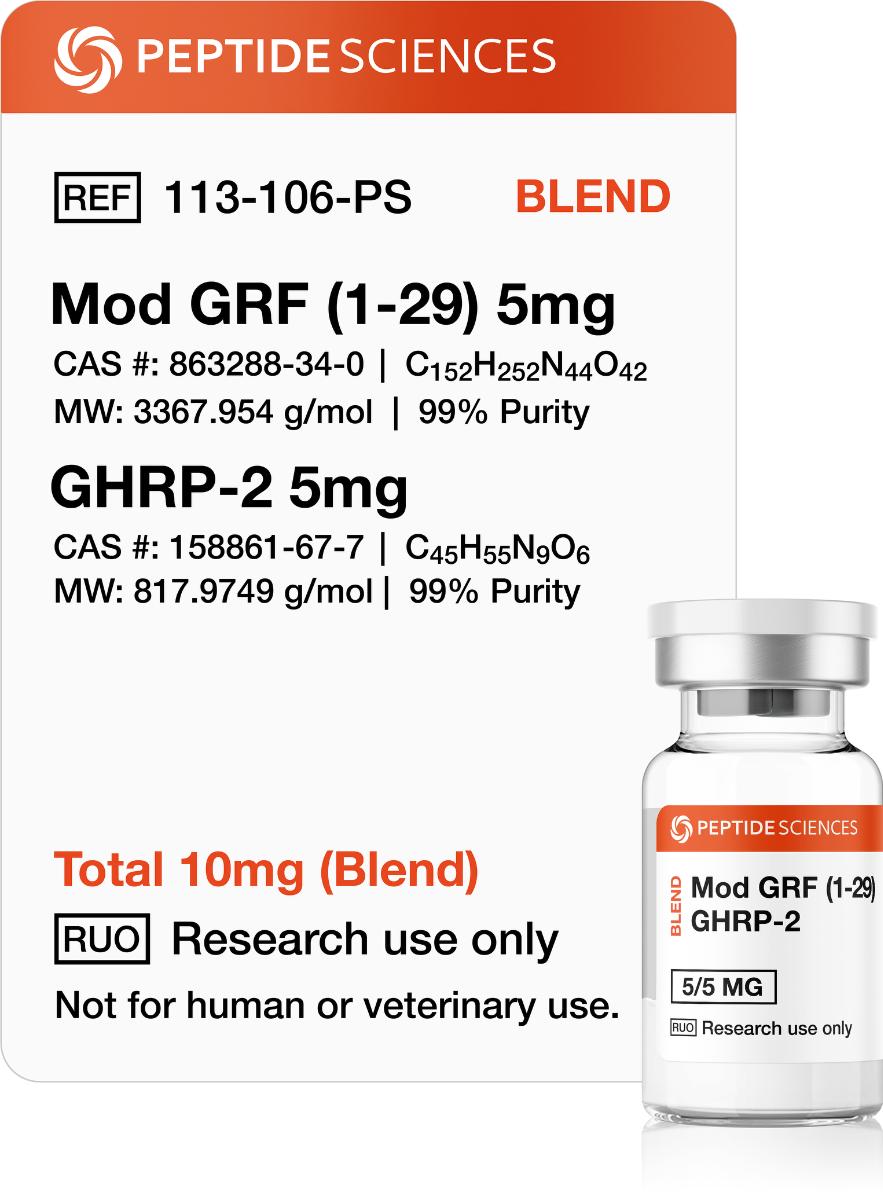
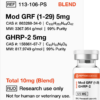
Mod GRF, GHRP-2 10mg (Blend)
$95.00
GHRP-2 is a synthetic growth hormone secretagogue that binds to the ghrelin/growth hormone secretagogue receptor. It has been shown in research trials to improve muscle growth, regulate the immune system, and improve sleep cycles. GHRP-2 research has shown that it has oral bio-activity. Buy GHRP-2 5mg
Growth hormone secretagogue receptor (GHSR) agonists like GHRP-2 are well known for their ability to produce large spikes in GH levels. These spikes, while providing a number of interesting and important benefits in animal models, are also short-lived because the half-life of most GHSR agonists is relatively short. To achieve long-term GH level increases, it is possible to use a GHRH analogue like modified GRF. This provides a long-term increase in both basal and peak GH levels, but nowhere near the kind of GH spike that a GHSR agonists provides. In addition, animal models show that GHRH analogues are susceptible to somatostatin interference, which can offset increases in GH levels.
To get the best of both worlds, research into combining GHSR agonists and GHRH analogues is being undertaken. One particularly researched combination is modified GRF with GHRP-2[1]. The synergy provides increased basal and peak levels of GH as well as measured spikes that boost the benefits of both peptides in ways that simply increasing one or the other cannot.
The net result of combining these peptides is improved GH release and substantial shifts in metabolism away from fat deposition. Lean body mass is increased substantially, insulin levels fall, and blood sugar becomes more regulated[2]–[4]. There is even evidence to show that both peptides, but particularly ipamorelin, can help to improve bone mineral density and bone health[5], [6].
About The Author
Research by L. Edmiston, M.D. for Peptide Sciences. L. Edmiston holds an M.D. from Case Western Reserve University School of Medicine and a B.S. in molecular biology.
Scientific Journal Author
Dr. Jan Izdebski has been listed as a noteworthy Chemist, researcher by Marquis Who’s Who. He attained a Master of Science from University Warsaw, Poland, 1959 and is a Doctor of Philosophy, University Warsaw, Poland, 1965, along with a Doctor of Science, University Warsaw, Poland, 1979. He studied how GRF 1-29 is more resistant to enzymatic degradation and how that affects its half-life.
Dr. Jan Izdebski is being referenced as one of the leading scientists involved in the research and development of GRF 1-29. In no way is this doctor/scientist endorsing or advocating the purchase, sale, or use of this product for any reason. There is no affiliation or relationship, implied or otherwise, between Peptide Sciences and this doctor. The purpose of citing the doctor is to acknowledge, recognize, and credit the exhaustive research and development efforts conducted by the scientists studying this peptide. Dr. Jan Izdebski is listed in [7] under the referenced citations.
Resources
- [1] M. Waelbroeck, P. Robberecht, D. H. Coy, J.-C. Camus, P. D. Neef, and J. Christophe, “Interaction of Growth Hormone-Releasing Factor (GRF) and 14 GRF Analogs with Vasoactive Intestinal Peptide (VIP) Receptors of Rat Pancreas. Discovery of (N-Ac-Tyr1,D-Phe2)-GRF(l-29)-NH2 as a VIP Antagonist,” Endocrinology, vol. 116, no. 6, pp. 2643–2649, Jun. 1985. [PubMed]
- [2] A. V. Schally, X. Zhang, R. Cai, J. M. Hare, R. Granata, and M. Bartoli, “Actions and potential therapeutic applications of growth hormone-releasing hormone agonists,” Endocrinology. [PubMed]
- [3] E. Adeghate and A. S. Ponery, “Mechanism of ipamorelin-evoked insulin release from the pancreas of normal and diabetic rats,” Neuro Endocrinol. Lett., vol. 25, no. 6, pp. 403–406, Dec. 2004. [PubMed]
- [4] D. E. Beck, W. B. Sweeney, M. D. McCarter, and Ipamorelin 201 Study Group, “Prospective, randomized, controlled, proof-of-concept study of the Ghrelin mimetic ipamorelin for the management of postoperative ileus in bowel resection patients,” Int. J. Colorectal Dis., vol. 29, no. 12, pp. 1527–1534, Dec. 2014. [PubMed]
- [5] N. B. Andersen, K. Malmlöf, P. B. Johansen, T. T. Andreassen, G. Ørtoft, and H. Oxlund, “The growth hormone secretagogue ipamorelin counteracts glucocorticoid-induced decrease in bone formation of adult rats,” Growth Horm. IGF Res. Off. J. Growth Horm. Res. Soc. Int. IGF Res. Soc., vol. 11, no. 5, pp. 266–272, Oct. 2001. [PubMed]
- [6] J. Svensson et al., “The GH secretagogues ipamorelin and GH-releasing peptide-6 increase bone mineral content in adult female rats,” J. Endocrinol., vol. 165, no. 3, pp. 569–577, Jun. 2000. [PubMed]
- [7] Izdebski, J., et al. “Potent Trypsin-Resistant HGH-RH Analogues.” Journal of Peptide Science : An Official Publication of the European Peptide Society [Semantics Scholar]
ALL ARTICLES AND PRODUCT INFORMATION PROVIDED ON THIS WEBSITE ARE FOR INFORMATIONAL AND EDUCATIONAL PURPOSES ONLY.
The products offered on this website are furnished for in-vitro studies only. In-vitro studies (Latin: in glass) are performed outside of the body. These products are not medicines or drugs and have not been approved by the FDA to prevent, treat or cure any medical condition, ailment or disease. Bodily introduction of any kind into humans or animals is strictly forbidden by law.
by Samantha Mitchell (verified owner)
“Quick turnaround time and solid product.”
by Caleb Jenkins (verified owner)
“I respect that Peptide Sciences sticks with USA made peptides. Not many brands do that anymore. Order came in on time and everything looked perfect.”
by Violet Perry (verified owner)
“I like that they stick with USA made peptides. Not many brands do that anymore. Still number 1 for me.”
by Marta Gallego (verified owner)
“Everything arrived safely and quickly.”
by Vlad Marin (verified owner)
“Everything arrived without any issues.”
by Kavya Menon (verified owner)
“The order was handled professionally.”
by Hudson Fraser (verified owner)
“The packaging was discreet and professional.”
by Emily Johnson (verified owner)
“Peptide Sciences delivers every time.”
by Penelope Russell (verified owner)
“Peptide Sciences has always been consistent and that hasn’t changed.”